My friends at Smith Publicity sent me this sweet children’s picture book. I can see young ones wanted to read this one again and again! It’s the perfect choice for the young dinosaur lover in your life.
Thank you for reaching out and for my copy which I will share with my school library!
Here’s the scoop:
The Day I Had a Dinosaur:
(MamaBear Books; 6/11/2024)
A fun-filled friendship story about our favorite prehistoric reptiles… Dinosaurs! When Luke and his friends have “real-life” dinosaurs for a day, there can only be one outcome, the best-osaurus day ever! Join these kind-hearted friends as they adventure through their day, ensuring that no dinosaur is left out, and everyone has fun working together.
—
ABOUT THE AUTHOR AND FOUNDER OF MAMABEAR BOOKS
Ashley Wall, M.Ed, is a Texas native, former teacher, and mother of two. Ashley has a Master’s degree in Curriculum and Instruction and a Bachelor’s of Science degree in Education. She is a passionate reader and writer who has been in the education field for over a decade.
Although she no longer calls herself a school teacher, Ashley has a passion for inspiring children through education and fostering big imaginations. Motivated by her own children’s huge imaginations and through playing make believe with them, Ashley created her book series featuring a fun-loving group of friends with larger-than-life adventures. Ashley has written three books, with another on the way, and she hopes her books will inspire children’s love for reading, develop their imaginations, and encourage acts of kindness and friendship.
When she’s not writing, Ashley loves spending time with her family and friends, reading with her two young children, puzzling, watching college football, and traveling.
ABOUT MAMABEAR BOOKS MamaBear Books is a family owned and operated boutique children’s book publishing company, founded by Jeff and Ashley Wall. Their goal is to meet the needs of children’s imaginations, creativity, and literacy through beautifully written and illustrated picture books. They focus on creating engaging stories and loveable characters for families to enjoy for generations.
MamaBear Books is partnering with the Barbara Bush Foundation to help promote literacy in children across Texas and the United States.
My friends at Books Forward sent this to me and I just could not stop reading it. It is a fascinating account of a missionary family in India during British colonial rule with a secondary viewpoint of their Indian servant “Arthur”. It was reminiscent of one of my favorite novels: The Poisonwood Bible by Barbara Kingsolver (so – big compliment there!!). This novel is a mash up of genres – part historical fiction, part romance, part coming-of-age story, part mystery. It was beautifully written and the characters are unforgettable.
Highly recommended!! Thank you so much for my copy!
Here’s the scoop:
Whisk away to India in this compulsive novel of two unlikely people who discover hidden truths about a high-ranking British official set against the backdrop of colonial rule. Sleeping in the Sun (October 22, 2024, She Writes Press) transports readers to the past where a young American and his Indian servant must face the reality behind a faithful family friend and the consequences of knowing this truth. A must-read for fans of The Poisonwood Bible and The Inheritance of Loss.
While originally a part of her MFA thesis at Pacific University, this explosive novel dives into the author’s own grandfather’s story of living as a Christian missionary in British India. Through her extensive research on the British Raj, the work of her grandfather’s missionary group, the effects of colonization in India, and the rich descriptions of India in the early 20th century, Joanne’s story weaves a cinematic tale of discrimination and privilege showcasing the enduring impact of imperialism and the spark of revolution.
In the last years of the British Raj, an American missionary family stays on in Midnapore, India. Though the Hintons enjoy white privileges, they have never been accepted by British society and instead run a boarding house on the outskirts of town where wayward native Indians come to find relief. Young Gene Hinton can’t get out from under the thumb of his three older brothers, and the only person he can really relate to is Arthur, his family’s Indian servant. But when Uncle Ellis, a high-ranking British judge, suddenly arrives and announces he’ll be staying indefinitely in their humble house, far from his prestigious post in Himalayan foothills, life as Gene knows it is interrupted. While his brothers are excited at the judge’s arrival, he is skeptical as to why this important man is hiding out with them in the backwaters of Bengal.
Also skeptical is Arthur. Then an Indian woman appears on their doorstep—and, after growing close to her, he learns the sinister truth about the judge. Torn between a family that has provided him shelter, work, and purpose his whole life and the escalating outrage of his countrymen, Arthur must decide where his loyalties lie—and the Hintons must decide if they can still call India home.
“Sleeping in the Sun”
Joanne Howard | October 22, 2024 | She Writes Press | Historical Fiction
Paperback | 9781647427986 | $17.99
Joanne Howard is an Asian American writer from California. She holds an MFA in writing from Pacific University. Her poetry received an honorable mention from Stanford University’s 2019 Paul Kalanithi Writing Award. Her fiction has been published in The Catalyst by UC Santa Barbara, The Metaworker Literary Magazine and the Marin Independent Journal and her nonfiction has been published in Another New Calligraphy and The Santa Barbara Independent. She lives in Santa Rosa, CA. Find out more at her website.
Books Forward also share an Interview with Joanna Howard, which I’m including below. These are not my questions, but they are good ones and I find her answers so interesting. I do admit to being fascinated by how authors craft their stories!
An Interview withJoanne Howard
What message do you hope to convey about colonialism and identity through the Hinton family’s story and interactions?
It’s definitely not a favorable portrait of colonialism; even though the main character, Gene, is a young boy with a naive view of the world, I didn’t want it to come off as unserious or easy going on the British Raj. But I also didn’t want history to be front and center to the book, but rather serve as a backdrop for the human story going on between the Hintons, Arthur, and the judge. Even though the novel is influenced by these huge forces of historical events, what I still hope readers take away is the detail of the everyday. When doing my research, my grandfather’s diary was filled with trivial but relatable things like feeling bored over the school break, being bewildered by the girls in his class, or getting jealous when one of his brothers got a new pair of glasses. I wanted to be sure to zoom in on details like that and see how they may actually convey the messages of the novel better than a more straightforward historical account.
How does the Hintons’ family story relate/differ from your own family’s history?
It certainly wasn’t as traumatic as the novel’s plot turns out, but there was still a lot of tension and uneasiness during that time period. And as my grandfather and his brothers moved to America and established families of their own here, the question remained: how do they think of India? Can they call it home? My grandfather was born and raised in India, and his first language was Bengali, but for the rest of his life he never returned to India because he knew it would have changed so much, and the India of his youth no longer existed. So this idea of “is India home?” I think was a question in real life for my grandfather and for the Hintons.
How does your background as an Asian-American writer influence your portrayal of cross-cultural interactions and historical events in your novel
I was able to draw from my own experience as a mixed-race Asian American to inspire this dual reality that the Hintons occupy, and to a lesser extent the space Arthur occupies as a converted Christian Indian who both works for the Hintons but wants to stay connected to his Indian identity. The novel’s setting where a range of racial identities all interact with each other is a huge aspect of the story, and I’m glad I could bring my personal experience to the work.
What are some of the most significant historical and cultural details that you included in the novel to bring the British Raj setting in India to life?
When it comes to bringing the setting to life, it’s all in the little details, from the hand-cranked ceiling fans (punkahs) to the nightly ritual of shaking out the bedding for any critters, all things that I found in our family archives. I also loved including a scene at the Gope Gargh (The Old Gope as the Hintons call it), which is now an ecological park that preserves the ruins of an old fort from the Mahabharata. I visited this park on my trip to India and was inspired by the mythical atmosphere and the way the forest had grown over the ruins of ancient civilization.
What did your research process look like when building the world of Sleeping in the Sun?
I have some amazing family members who have taken on the task of archiving a lot of our first-hand accounts, from autobiographies to diaries to just a treasure trove of well-preserved photographs. So I had a lot of historical material to work off of when it came to bringing the Hinton family to life. For Arthur’s character, I just tried to expose myself to as many literary works that matched his background and the time period, and two books especially inspired his character: The Autobiography of an Unknown Indian by Nirad C. Chaudhuri and Pather Panchali by Bibhutibhushan Bandyopadhyay. And lastly, I took a 3-week trip to India in 2018 to visit some of the locations that appear in the novel.
What advice would you give to a writer who is trying to write beyond their own lived experiences? What is important to remember regarding sensitivity in writing?
My view is that art does not require permission, but it does require respect and compassion, especially if it’s a loaded topic like colonialism that may still leave scars on potential readers. I think writers should be able to write whatever they want, and we see plenty of celebrated works out there that don’t align with the author’s lived experience or identity. It becomes problematic when there is a kind of deception on the author’s part where they try to sell themselves as part of that identity, or when there is a disproportionately large amount of publishing dollars allocated to an author from a more privileged background while works by own voices don’t get that same amplification. Historical fiction specifically is tricky because it is often pointed to as a source of truth for what that time period was like, when I don’t think it should be, since it is fiction after all.
But as for what a writer can do: do your research, write with respect, and work with a sensitivity reader who can catch any of your blindspots. Understand that you will never be able to relate 100% to the identity or community you are writing about, and that’s ok. If you have done it well, the work should stand on its own merit, regardless of who the author is.
My friends at Books Forward sent me some information on this new novel, featuring the author’s ancestor who came to American from Norway and was institutionalized in a mental hospital for most of her life.
The Blue Trunk traces the journey of Marit Sletmo as she comes to America and the quest of her great great niece, Rachel, as she seeks to discover Marit’s story, while writing her own.
Here’s the scoop:
When Ann Lowry inherited an ancestor’s blue travel trunk, she had no idea that this artifact was about to take her on a three-year journey of discovery. She was told that the trunk’s previous owner, a great-great aunt, had been institutionalized for insanity. Despite meticulous genealogy research, she was unable to uncover any facts about her and concluded that she must have spent her entire adult life in an asylum. Lowry was inspired to write The Blue Trunk, (Sept. 10, 2024, Koehler Books) to help reclaim her ancestor’s voice and shed light on these all-too-common institutionalizations. Seamlessly weaving historical fiction with contemporary life, Lowry’s tale explores identity, strength, and connection across decades.
Rachel Jackson’s idyllic life takes a dramatic turn when she discovers a woman’s scarf in her politician husband’s computer bag. But in an election year, seeking answers to questions of infidelity is not an option. When her mother gives her a family heirloom, a travel trunk owned by an ancestor, she finds a distraction. As she immerses herself in its contents, she discovers a woman whose life is vastly different from her own. Or is it?
Determined to dispel the notion that her ancestor Marit was insane, Rachel sets out to unveil her unknown story. In the interwoven narratives of these two women, who are bound by blood and a shared struggle, The Blue Trunk is a poignant exploration of identity, love, and unwavering strength.
Here’s a bit about Anne:
Ann’s journey into the realm of storytelling was foretold by a Sedona psychic in 2001. That prophecy became a reality two decades later when Ann discovered a family heirloom, a travel trunk from Norway, which sparked the genesis of her debut novel, “The Blue Trunk.”
A writer her entire life, Ann holds a Ph.D. in Communication from the University of Minnesota. Her career has been dedicated to teaching and helping others navigate communication and resolve conflicts. Ann is fascinated by the dynamics of relationships, discord, and the intricacies of the human condition. Ann successfully completed the Loft Literary Center’s Novel Writing Intensive course in 2022.
Alongside her passion for fiction, she has contributed to academic journals, penned thought-provoking opinion pieces, crafted engaging content for online platforms, and provided insights on the federal management of disasters.
When Ann isn’t immersed in the world of writing, she finds solace in the pool or the lake. She cherishes playful moments with her rescue-turned-therapy dog, Loki, and also enjoys reading, golfing, and indulging in the art of cookie and bread baking. Fly fishing is her newest hobby. Most of all, she savors precious time with her family.
Ann and her spouse, Karen, and fur child, Loki, live in Timnath, Colorado, where they enjoy the beauty of nature daily. Learn more about Ann at: www.annlowry.com
I loved this story because not only was it a story within a story, but it had a focus on strong women, as well as resilience and identity. I loved the ending and was so hopeful that the story was largely based in fact. So I asked if I could do a Q&A with Ms. Lowry, and here it is!
BBNB: Hi there! I really enjoyed your novel so much. I’m curious. Is there really a blue trunk? And how did you first get interested in your ancestor’s story?
Yes, there is a blue trunk. It still sits in the foyer of my home in Colorado and has the name “Marit Sletmo” painted on the front. My mother inherited the trunk and while I was aware of the fact that my great-great aunt used it when she immigrated from Norway, I knew nothing of her life until I suggested naming my daughter “Marit.” My mother reacted to my suggestion with horror telling me that Marit was “insane” and that she and her sisters were never allowed to talk about her. Needless to say, I didn’t name my daughter after her. But I thought of her, of course, every time I saw the trunk. A few years ago my mother gave me the trunk and I started researching her on genealogy websites. But my research came to a dead end rather quickly. I concluded, sadly, that Marit likely spent her entire life in an institution. I knew I wanted to reclaim her life by writing a novel about her.
BBNB: As a person who studied psychology in college, your novel reminded me of the truly inhumane ways that people with mental illness were treated. How did you research that part of your novel?
The National Institute of Health and the Library of Congress have good information. But probably the most compelling information for me came from information gleaned from investigative journalist Nelly Bly. In 1887, Bly had herself committed to the “lunatic asylum” on Blackwell’s Island in New York. She spent ten days there and documented the horrific conditions that existed there at that time and noted that some women were sane but had been committed by family members who wanted them out of the way.
BBNB: Is Marit’s journey very similar to your own great aunt’s? Did you have that level of detail of her life or did you have to use some creative license? Did you have to track down clues to find answers like Rachel did in the novel?
Most of the book is fiction because I reached a dead end early with my genealogy research. I had an autograph book that she had signed in Wisconsin (my only clue) and I knew that she had indeed made it to the United States and that she could speak English fluently (given the poem she wrote in the autograph book). But I learned through my research that asylum patients were not always included in the census and that they sometimes weren’t issued death certificates. Census data and death and marriage certificates are ways that you can track ancestors and I couldn’t find anything for her. She essentially became “unknown.” I had originally named the book “The Life I Wished for You” because a lot of it was from my imagination, but my publisher prefered The Blue Trunk (also a fine title). I wanted Marit to have a good life. Her created life isn’t easy in the book, but she is resilient and strong and in order to portray that, I needed her to have some challenges. Ultimately she overcomes her challenges and thrives.
BBNB: I have to ask: did your great aunt have a happy ending like Marit? I do love happy endings…
Unfortunately, I don’t think she did. I suspect she spent her remaining life in an institution. But she has a happy ending in the novel and that was important to me. I love what she became (in the book) and love the fact that if you now search her name, you will find it. She is no longer unknown.
BBNB: Are you working on something new right now (or “write now”)?
I am! I am writing about four women friends who were WASP’s during WWII. The women of the Women’s Air Corp flew planes across the country for the military plane repositioning. They were amazing and brave women. In spite of their service, they weren’t awarded military benefits until President Jimmy Carter awarded veteran’s status in 1977. The book is loosely based upon the life of my real aunt who was a WASP and flew six different planes during her tour of duty. That said, the book is mostly about family drama, romance, and being a strong and resilient woman.
Thank you so much for my copy and for answering my questions.
I loved this story and I look forward to more novels by Ann Lowry!
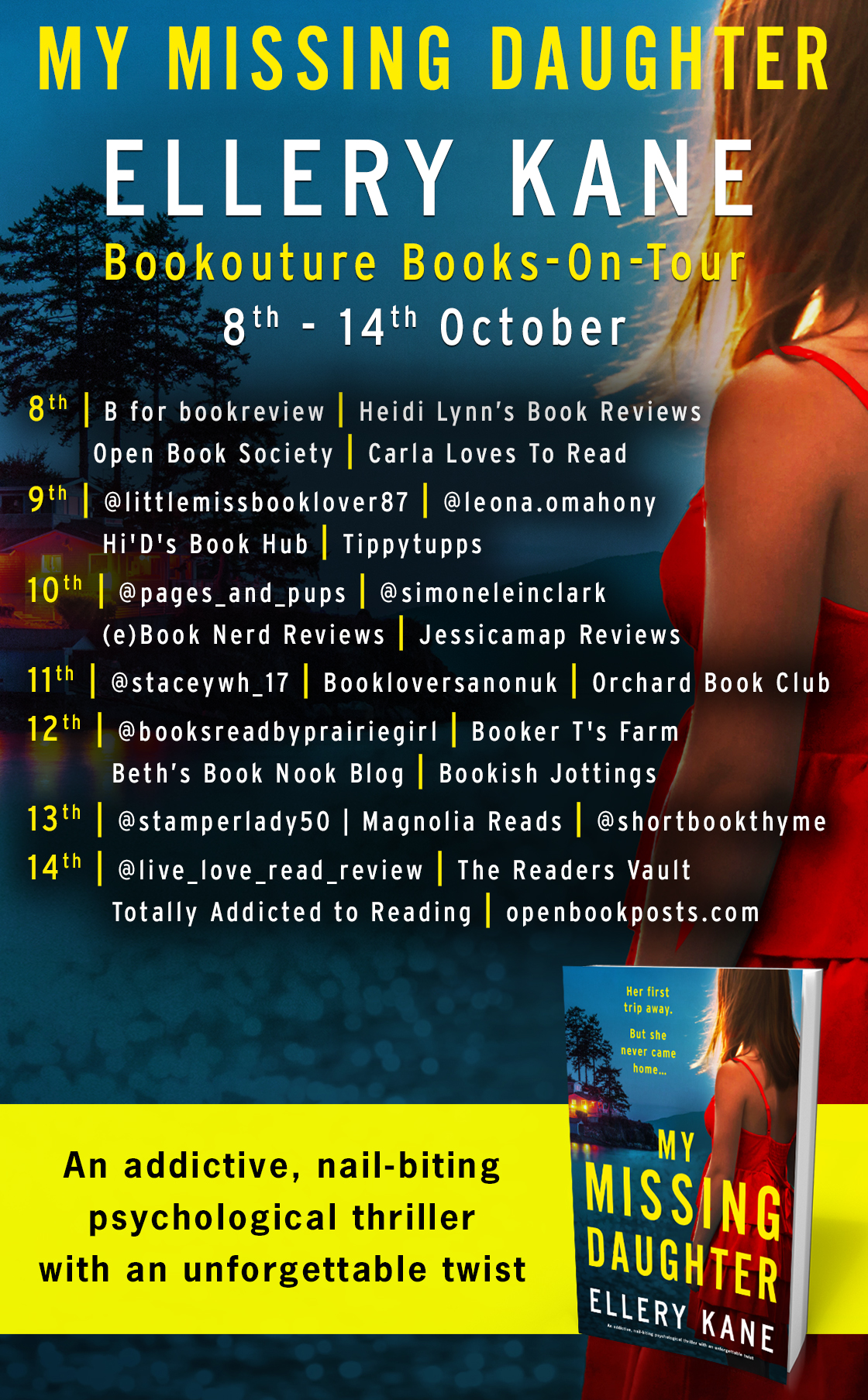
Okay – this was a twisty, suspenseful thriller that kept me guessing and guessing. Hard to put down, I was happy with the ending! The story toggles between a mother, dealing with her missing daughter who went on a road trip with her best friend, and the road trip as it happened.
So. Many. Secrets. (that’s all I’ll say!)
Book Description:
It’s her first trip away. But she never came home…
The old camping bus pulls up outside my house in the middle of the night. Rain is pounding against the windows, thunder rattling, but I’d recognize the sound of the engine anywhere.
Confusion races through me. My daughter Willow and her best friend must be back early from their trip. I jump up and rush to meet them.
But when I pull open the door, it’s not Willow on the doorstep. It’s a man, holding her keys. Blood roars in my ears as he explains he was hired anonymously to drive it back.
My heart is pounding. I don’t understand. Where is my daughter?
I push past him and run out into the rain, wrenching the door of the bus open. It’s empty. The girls are gone.
And in the back, there are signs of a struggle. Clumps of Willow’s hair on the floor. Their belongings trashed. I stop breathing.
Where are they? What’s happened to my daughter? And churning in my stomach is the most terrifying question of all: What will it take to get her back?
A jaw-dropping, unputdownable psychological thriller packed with twists that will leave you breathless. Perfect for fans of Shari Lapena, Lisa Jewell and Lucy Clarke’s One of the Girls.
Author Bio:
Forensic psychologist by day, author by night, Ellery Kane has been writing professionally and creatively for as long as she can remember. Real life really is stranger than fiction, so Ellery’s writing is often inspired by her day job. Before writing the Rockwell and Decker series with Bookouture, Ellery published the Legacy series for young adult readers and the Doctors of Darkness series of psychological thrillers. She was previously selected as one of ten semi-finalists in the MasterClass James Patterson Co-Author Competition. A Texan at heart, Ellery currently resides in the San Francisco Bay Area.


 Beth's Book-Nook Blog